
Managing Salt Build-Up on Orchid Bark

Using a Humidity Tray for Orchids
When growing orchids indoors, especially moisture-loving genera like Bulbophyllum, many growers turn to humidity trays to compensate for dry air.
It’s a good idea in theory—but if not managed carefully, it can quietly create one of the most damaging problems in orchid culture: salt accumulation in the root zone.
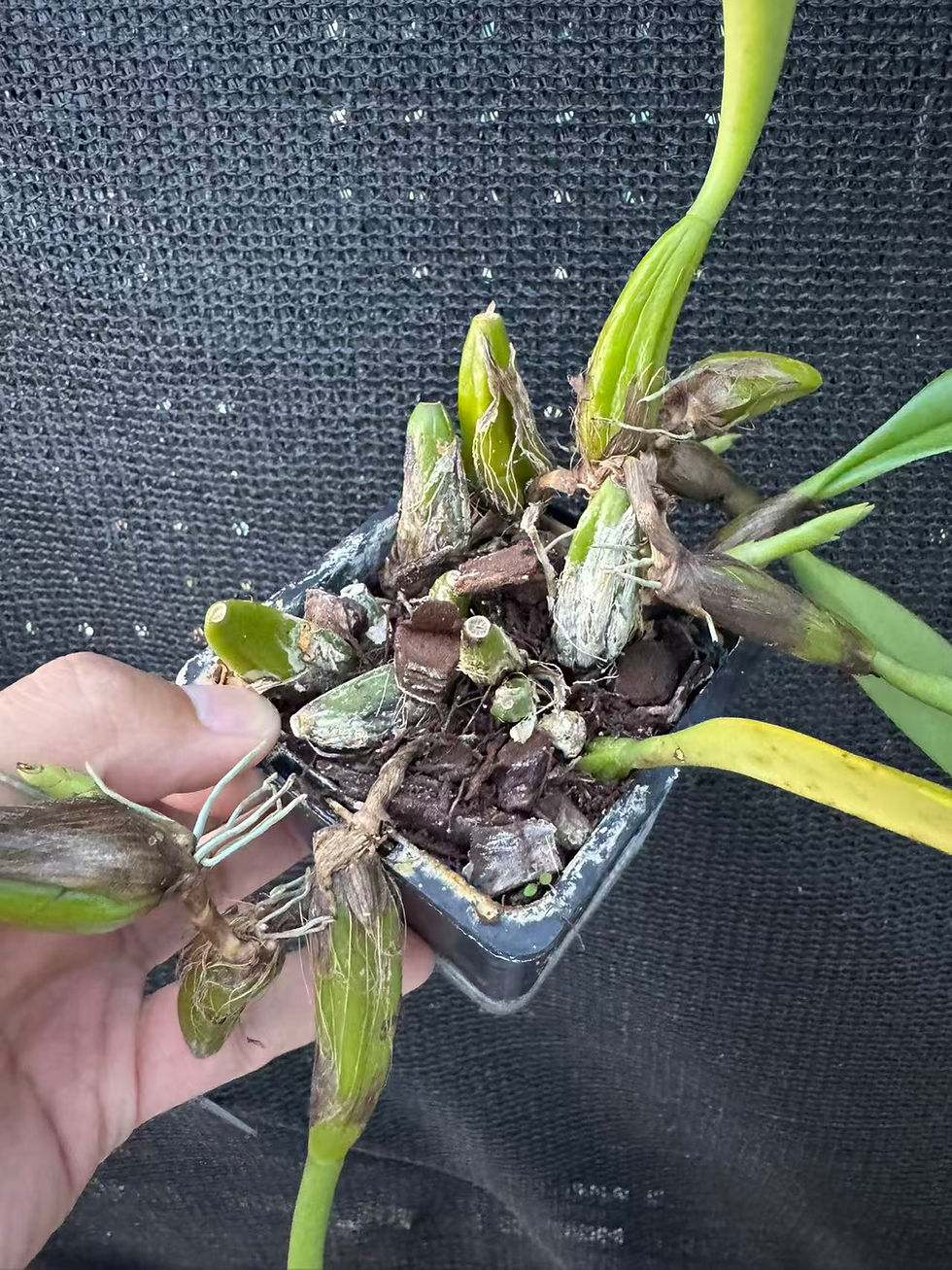
The plant shown left is a typical example.
What We Are Seeing
Looking closely at this plant:
A white crust has formed on the pot and bark surface
Several pseudobulbs are shriveling or weakened
Leaves are beginning to yellow
Roots appear brown and compromised
This combination almost always points to salt stress combined with excessive moisture.
Why Salt Builds Up
Unlike in nature, where orchids are constantly flushed by rain, potted orchids live in a closed system.
Over time, salts accumulate from:

Fertilizer residue
Minerals in tap water
Even the bark itself
When a plant is kept consistently moist—especially in a tray environment—these salts are not washed away. Instead, they concentrate around the roots.
The Hidden Risk of Humidity Trays
Humidity trays are often misunderstood.
They are meant to:
increase ambient humidity
They are not meant to:
keep the root zone constantly wet
If the pot sits too close to water, or if evaporation continually wicks minerals upward, the result is exactly what we see here:
salt buildup
oxygen deprivation
root decline
How to Fix It
Flush the Medium
Take the plant to a sink and run clean water through the pot for several minutes. This helps dissolve and remove accumulated salts.
Repot if Necessary
In cases like this, repotting is usually the best option.
Remove old bark
Trim dead roots
Use fresh, pre-soaked bark
Add charcoal to help buffer impurities
Adjust Water Quality
Avoid:
salt-softened water
Use instead:
rainwater
reverse osmosis water
or tap water that has been left to sit
Reduce Fertilizer Load
A safer approach:
Use half-strength fertilizer or less
Follow a 3-week feed, 1-week flush cycle
Using a Humidity Tray Correctly
The pot should sit above the water, not in it
Use pebbles or a rack to elevate the pot
Ensure good airflow at all times
Humidity should surround the plant—not saturate the roots.


A Practical Perspective
Bulbophyllums are often described as “water-loving,” but that can be misleading.
They thrive in:
high humidity
frequent watering
But they decline quickly in:
stagnant conditions
salt-heavy media
Final Thought
In orchid growing, problems rarely come from a single factor.
In this case, it’s the combination of:
constant moisture + mineral accumulation
Managing one without the other is not enough.
Salt buildup is rarely caused by a single factor.
It is usually the result of:
Frequent fertilizing
Mineral-heavy water
Constant moisture without flushing
Understanding this interaction is key to long-term orchid health.
Managing salt levels is not just maintenance—it is essential for keeping roots alive and functional.


I read this article carefully and found many interesting points. The tone is professional without being too formal or difficult to read. I took notes on some of the points that seemed particularly relevant. It is a text that provides a clear and well-organised view of the topic.
The article is well structured and the ideas are expressed clearly. I appreciated the completeness with which the various aspects are treated. I saved this text so I can reread it in the future when I need it. It is content useful both for those approaching the topic for the first time.
The article presents a critical perspective on managing humidity for orchids, particularly for those that thrive in moist environments. The concept of using humidity trays, while beneficial, has its caveats. It emphasizes the need for balance; without proper flushing, salt accumulation can hinder root health. For orchid growers, understanding these dynamics, including the role of Lukki in moisture management, is vital for sustaining plant vitality.
The discussion on humidity trays highlights the complex relationship between moisture and salt accumulation, particularly in species like Bulbophyllum. It's essential to realize that while these plants may seem to thrive in wet conditions, the concept of Rollero can complicate their care. Balancing moisture and salt levels is crucial; neglecting this could lead to serious consequences for plant health.
This article highlights the complexities of growing orchids, particularly regarding moisture management and the issue of salt accumulation. While humidity trays can be beneficial, they also pose risks if not monitored closely. The interaction between moisture and salt levels is significant; understanding this relationship is crucial for healthy orchids, especially for species like Caxino which thrive in specific conditions. Ultimately, nuanced care is necessary.